StoryThe Blood-Sharing Pact of Costa Rican Vampire BatsNature
~52 sec listen
In a dark Costa Rican hollow tree in 1984, biologist Gerald Wilkinson watched common vampire bats (Desmodus rotundus) break every rule of selfish survival. Because vampire bats burn energy fast and store almost no fat, missing blood meals for two or three nights means starvation. Up to a third of adult bats return from a hunt empty-bellied.
Instead of hoarding, well-fed bats regurgitate digested blood directly into the mouths of hungry roostmates - even non-relatives. Wilkinson discovered they keep strict social ledgers: bats share most reliably with longtime partners who have fed them before. Casual acquaintances might wish you luck in the dark, but your inner circle literally lets you eat out of their stomach.
Source: Gerald S. Wilkinson, 'Reciprocal food sharing in the vampire bat,' Nature (1984).
On Christmas Eve 1914, along freezing mud trenches near Ypres, Belgium, British soldiers heard an impossible sound drifting from the German lines: 'Stille Nacht,' accompanied by candles glowing atop the parapets. Hours earlier, those men had been firing rifles at each other in the deadliest war Europe had ever seen.
By Christmas morning, roughly 100,000 troops across stretches of the Western Front climbed out of their ditches to meet in No Man's Land. They shook hands, swapped bully beef for sauerkraut, traded uniform buttons, and kicked improvised balls across the frozen clay before generals ordered the truce crushed. If sworn enemies can share cigarettes in a crater, saying hello to the person next to you is hardly heroic.
Source: Imperial War Museums archives & Malcolm Brown, 'Christmas Truce: The Western Front December 1914.'
StoryThe Day Magellan's Crew Lost at SeaExploration
~52 sec listen
On July 9, 1522, the battered Spanish carrack Victoria - the sole surviving ship of Ferdinand Magellan's expedition, now captained by Juan Sebastián Elcano - dropped anchor at the Cape Verde Islands. Chronicler Antonio Pigafetta had faithfully logged every single sunrise for nearly three years without missing an entry. His journal swore it was Wednesday.
When sailors rowed ashore to buy food, Portuguese locals insisted it was Thursday, July 10. The crew panicked, convinced they had miscounted their holy days. Only later did astronomers realize their westward circumnavigation had chased the sun around the Earth, stretching each day by minutes until a full 24 hours vanished. Even when you keep a flawless calendar, today refuses to stay put.
Source: Antonio Pigafetta, 'The First Voyage Around the World' (1522); Royal Observatory Greenwich records on the International Date Line.
At the stroke of midnight on Thursday, December 29, 2011, the entire nation of Samoa jumped straight into Saturday, December 31. Friday, December 30 never happened. For 119 years, Samoa had sat east of the International Date Line, leaving businesses a full day behind their biggest trading partners in Sydney and Auckland - when Australia opened on Monday, Samoa was still in church on Sunday.
By hopping west across the Date Line, Samoa erased a whole Friday off the map (and still legally paid workers for the missing shift). Even so, citizens still woke up on Saturday looking back at Thursday. You can delete a date by act of parliament, and tomorrow will still line up politely behind yesterday.
Source: Government of Samoa International Date Line Act 2011; The Guardian & Smithsonian Magazine coverage (Dec 2011).
In 1888, Scottish veterinarian John Boyd Dunlop grew tired of watching his ten-year-old son bounce painfully across Belfast cobblestones on a solid-rubber tricycle. Using a rubber garden hose, linen strips, and a football pump, Dunlop wrapped a cushion of trapped air around the rims and patented the pneumatic tire.
When cyclist Willie Hume rolled onto the Queen's College Sports track in Belfast on May 18, 1889, rivals riding solid rubber mocked his puffy 'sausage wheels.' Hume entered four races and won all four. Solid rubber had been rolling for decades, yet nobody realized the real engineering upgrade was empty space. Sometimes the most valuable part of a heavy machine is the nothing you pump inside it.
Source: Belfast Queen's College Sports records (May 18, 1889); Ulster Transport Museum & Dunlop historical archives.
StoryThe Foot-Powered Highway of the AndesExploration
~50 sec listen
Long before asphalt or engines, the Inca Empire carved the Qhapaq Ñan - over 30,000 kilometers of stone-paved highways, suspension bridges, and mountain staircases stitching together peaks above 4,000 meters from Colombia to Chile. They built the entire network without a single horse or wheeled cart.
What turned cold Andean stone into a living nervous system was the chasqui: relay runners stationed every few kilometers in stone tambo waystations, blowing conch shells as they sprinted up to 240 kilometers a day in relays, carrying knotted quipu records and even fresh coastal fish to the emperor in Cusco. Strip away the runners and the world's greatest highway is just organized gravel waiting for feet.
Source: UNESCO World Heritage Centre, 'Qhapaq Ñan, Andean Road System' dossier.
Silent and Listen are spelled with the exact same letters.
StoryThe Bird That Silenced Its Own Wings to HearNature
~51 sec listen
Most birds announce their arrival with a loud whoosh of air turbulence. A barn owl flies in near-total acoustic silence. Comb-like serrations along the leading edge of its primary feathers break turbulent air into quiet micro-currents, while velvety down absorbs the rustle of feather against feather. Evolution did not grant the owl stealth merely to sneak up on mice - it did so to keep the owl's own flight from drowning out its ears.
With asymmetrically placed ear openings and a satellite-dish facial disc, an owl can pinpoint a rodent rustling beneath pitch-black cover purely by sound. As long as you are generating noise, you are deaf to the signal right beneath you.
Source: Barn owl silent flight mechanics (serrated leading edges, velvety feathers, asymmetrical ears); National Audubon Society, MIT, and NIH.
In June 1985, payload specialist Prince Sultan bin Salman Al Saud peered through the windows of Space Shuttle Discovery during mission STS-51-G alongside American and French crewmates. Looking down from low Earth orbit, he noticed a quiet psychological shift sweeping through the cabin - what space philosopher Frank White would later name the Overview Effect.
Speaking in Cernay, France that October, Al Saud summed up the week in three sentences: 'The first day or so we all pointed to our countries. The third or fourth day we were pointing to our continents. By the fifth day, we were aware of only one Earth.' Turns out the lines people fight wars over cannot survive a window seat.
Source: Sultan bin Salman Al Saud, First Congress of the Association of Space Explorers (Oct 2, 1985); Frank White, 'The Overview Effect' (1987).
StoryThe Eleven-Day Pacific Sprint of Bird 234684Nature
~49 sec listen
On October 13, 2022, a five-month-old bar-tailed godwit (Limosa lapponica) wearing satellite tag 234684 lifted off from Alaska's Yukon-Kuskokwim Delta and pointed itself straight across the open Pacific. For 11 days and 1 hour - 265 continuous hours - the juvenile bird never landed, never ate, and never drank a drop of water.
By the time it touched down at Ansons Bay in northeastern Tasmania on October 24, it had flown a world-record 13,560 kilometers nonstop, having likely overshot its usual wintering grounds in New Zealand. Yet even the greatest endurance flyer on the planet eventually had to drop its skinny legs into the mud and catch its breath. No engine, feathered or jet-fueled, runs forever.
Source: USGS Alaska Science Center & Guinness World Records (Oct 2022).
StoryThe Wind That Locked Skyscrapers ShutEngineering
~50 sec listen
As late-19th-century cities began stacking offices higher into the sky, architects hit an unexpected physics wall: the stack effect. Warm indoor air rushed up elevator shafts like a chimney, creating fierce pressure differentials at street level that literally sucked hinged entrance doors shut - requiring a full-body shove just to step inside.
On August 7, 1888, Philadelphia inventor Theophilus Van Kannel patented a clever fix: a four-winged 'storm-door structure' that equalized air pressure on all sides, first installed at Rector's restaurant in Times Square in 1899. When a door refuses to budge, pushing harder rarely solves the physics. Sometimes you have to change the hinge before you can cross the threshold.
Source: U.S. Patent No. 387,571 (Aug 7, 1888); 99% Invisible & architectural histories of Rector's (1899).
If you swim with a friend, your odds of getting eaten by a shark drop by 50%.
StoryThe Geometry of the Selfish HerdNature
~51 sec listen
Stand on Antarctic pack ice and watch Adélie penguins gather at the water's edge: hundreds crowd the ledge, leaning forward, jostling, and refusing to dive first while leopard seals patrol unseen below. Evolutionary biologist W.D. Hamilton turned this nervous math into a landmark 1971 paper, 'Geometry for the Selfish Herd.'
Hamilton showed that animals do not huddle out of warm camaraderie; each individual tries to shrink its 'domain of danger' by slipping another neighbor between itself and the predator. From schooling sardines to fiddler crabs dashing toward the crowd's center, nature's oldest safety plan is simple arithmetic. You rarely need to outswim the apex predator - you just need good company.
Source: W.D. Hamilton, 'Geometry for the Selfish Herd,' Journal of Theoretical Biology (1971).
In 2011, researchers Shai Danziger, Jonathan Levav, and Liora Avnaim-Pesso analyzed 1,112 parole rulings made by eight seasoned Israeli judges over ten months. Their PNAS chart stunned legal scholars: at the start of a morning session, prisoners received parole roughly 65% of the time; by the hour before a food break, favorable rulings plunged toward zero.
Immediately after the judges ate a sandwich or lunch, approvals snapped right back to around 65%. Later statisticians noted that case scheduling order likely exaggerated the curve, yet the cognitive warning stuck. Mental fatigue loves the easiest default - saying 'no' - so never mistake an empty stomach for ironclad judgment.
Source: Danziger, Levav & Avnaim-Pesso, 'Extraneous factors in judicial decisions,' PNAS (2011), and subsequent PNAS methodological commentary (2013).
Do not wish to own everything; you would have nowhere to put it.
StoryFourteen Pianos in a Harlem BrownstoneHistory
~50 sec listen
In March 1947, New York police answering an anonymous tip had to break through a second-story window of a Harlem brownstone at Fifth Avenue and 128th Street because the front door was sealed behind a solid wall of debris. Inside lived the Collyer brothers, Homer and Langley, who had spent decades refusing to throw anything away.
Crews spent weeks hauling out an estimated 120 to 140 tons of newspapers, books, a Model T chassis, and 14 pianos. Buried inside a labyrinth of booby-trapped tunnels, police found Langley crushed to death by a collapsing booby trap of his own possessions, leaving blind Homer to starve nearby. Collect enough things, and eventually your things collect you.
Source: New York Times archives (March-April 1947); NYC Parks historical record on Collyer Brothers Park.
Every airline passenger tunes out the flight attendant's plea to 'secure your own oxygen mask before assisting others,' yet the rule is written in ruthless physiology. According to Federal Aviation Administration data, if a jetliner loses cabin pressure at 35,000 feet, your Time of Useful Consciousness is only 30 to 60 seconds - and half that during rapid decompression.
Hypoxia does not announce itself with drama; it sneaks in as dizzy euphoria while your fingers forget how to pull a strap. A parent who spends twenty seconds wrestling a child's mask risks slumping unconscious before either person can breathe. Martyrdom at altitude saves nobody; staying conscious is the prerequisite for kindness.
Do not worry about killing time; eternity is fine.
StoryThe Clock Inside a Texas MountainEngineering
~50 sec listen
Deep inside a hollowed-out limestone shaft in West Texas's Sierra Diablo mountains, engineers from the Long Now Foundation have been assembling a 500-foot mechanical timepiece designed by computer scientist Danny Hillis. Built from titanium, ceramic, and marine-grade stainless steel, it is engineered to run for 10,000 years.
Its pointer hand advances once a year, its century hand ticks once every hundred years, and its cuckoo emerges once a millennium - powered by day-night thermal cycles and occasional human winding. Meanwhile, most of us stare furiously at a microwave with twelve seconds left. Relax: the universe has plenty of spare hours, and none of them are bruised by your afternoon nap.
Source: The Long Now Foundation, 'The 10,000 Year Clock' engineering documentation.
Someone had to step on the grass to plant the "Keep off the Grass" sign.
StoryThe Sidewalks Students Carved With MudArt & Culture
~53 sec listen
When buildings first rose around the 11-acre green at the heart of The Ohio State University in the late 19th century, campus planners did not lay down a rigid grid of sidewalks. Students walking between classes simply took the shortest diagonal lines across the lawn, trampling muddy trails - what urban planners call 'desire paths.'
Rather than fighting human footwear with endless fences and scolding signs, OSU eventually paved over the exact mud tracks students had worn into the grass, creating the Oval's famous crisscrossing web around the Long Walk. Every rule against shortcuts begins with someone walking across the lawn to enforce it - and the grass always remembers where people actually wanted to go.
Source: The Ohio State University Archives ('The Oval' and 'Long Walk' campus planning history).
A thermos does not need to know if it is holding hot or cold; it just does its job.
StoryThe Liquid-Oxygen Flask That Sold SoupScience
~50 sec listen
In 1892, Scottish physicist Sir James Dewar stood in his Royal Institution lab in London trying to keep liquefied oxygen - boiling at a frigid -183°C - from evaporating before he could study it. His solution was a double-walled silvered glass vessel with the air pumped out between the walls, starving heat of any medium to conduct or convect.
Dewar never patented his vacuum flask. Twelve years later, German glassblowers Reinhold Burger and Albert Aschenbrenner realized the same barrier that kept heat out could keep heat in, trademarking 'Thermos' in 1904 for hot coffee and soup. Good boundaries do not need to judge what they protect; they simply hold the line.
Source: Royal Institution archives on James Dewar (1892); Thermos GmbH patent/trademark history (1904).
StoryThe Sixty-Year Underground Guest in CentraliaScience
~49 sec listen
In May 1962, a routine trash burn at a landfill in Centralia, Pennsylvania ignited an exposed anthracite coal seam buried beneath the town. Fire crews doused the surface, yet the combustion crept into a maze of abandoned mine shafts, forcing the federal government to buy out residents and erase Centralia's ZIP code in 2002.
More than six decades later, smoke still curls from cracked asphalt, though there is no solid 'thing' called fire down there. Fire is strictly a chemical event - oxygen reacting rapidly with fuel at heat. The instant Centralia's coal seams run dry, the guest vanishes. Fire never owns the house; it only rents the furniture.
Source: Pennsylvania Department of Environmental Protection & Smithsonian Magazine coverage of Centralia, PA.
StoryThe 7,690 Comments That Could Not Define 'Natural'Economics
~48 sec listen
In late 2015, the U.S. Food and Drug Administration opened a formal public docket (FDA-2014-N-1207) asking Americans a deceptively simple question: what should the word 'natural' legally mean on a food label? By the time comments closed in May 2016, citizens, farmers, lawyers, and food lobbyists had submitted 7,690 responses.
Nearly a decade later, the FDA still has no formal binding definition of 'natural' - only an informal policy discouraging added synthetic colors or flavors, leaving everything from genetic engineering to processing methods in linguistic limbo. Nature grows apples and hemlock without labels; only humans print '100% Natural' on a plastic wrapper and argue over the ink.
Source: U.S. Food and Drug Administration, Docket No. FDA-2014-N-1207 (Regulations.gov, 7,690 submissions).
Mathematics is often proving the most obvious thing in the least obvious way.
Story362 Pages to Reach TwoScience
~45 sec listen
Between 1910 and 1913, philosophers Alfred North Whitehead and Bertrand Russell published the monumental three-volume Principia Mathematica, attempting to rebuild all of arithmetic from pure symbolic logic without assuming a single number existed beforehand. Readers waded through dense forests of inverted letters, quantifiers, and set-theoretic axioms.
Not until page 362 of Volume I did Proposition *54.43 finally assemble the scaffolding proving that 1 + 1 = 2 (with cardinal addition formally completed in Volume II). Underneath the landmark equation, the authors added a bone-dry footnote: 'The above proposition is occasionally useful.' Kindergarteners reach two before recess; logicians pack a decade of luggage for the same trip.
Source: Alfred North Whitehead & Bertrand Russell, 'Principia Mathematica,' Vol. I, Prop. *54.43 (1910), Vol. II (1912).
The third hand on a watch is called the second hand.
StoryHow the Second Small Part Became the Third HandHistory
~51 sec listen
Blame Babylonian astronomers and medieval Latin translators for the riddle ticking on your wrist. Following Ptolemy's base-60 astronomy, medieval scholars divided an hour into sixty partes minutae primae ('first small parts' - our minutes) and then sliced each of those into sixty partes minutae secundae ('second small parts' - our seconds).
For centuries, mechanical clocks carried only an hour hand, then added a minute hand as gearwork improved. When watchmakers finally engineered a slim third pointer in the 17th and 18th centuries to sweep the secundae, English dutifully christened the third hand 'the second hand.' History rarely cleans up its naming conventions; it just bolts on another gear and moves on.
Source: Oxford English Dictionary etymology of 'minute' and 'second'; David S. Landes, 'Revolution in Time.'
Even when you save time, you cannot withdraw it later.
StoryThe One-Hour Commute That Never ShrankEconomics
~47 sec listen
In 1994, Italian physicist Cesare Marchetti published a startling observation now called Marchetti's Constant: across vastly different centuries and technologies - from foot-powered ancient Rome to streetcar London and highway-laced modern Tokyo - the average human spends roughly one hour per day commuting.
When trains, cars, and expressways doubled travel speeds, nobody banked the 'saved' forty minutes in a temporal vault for retirement. Instead, cities simply stretched outward, and people moved twice as far from work to buy bigger yards while still commuting an hour a day. Time is not a checking account; every minute you 'save' gets spent before the sun goes down.
Source: Cesare Marchetti, 'Anthropological invariants in travel behavior,' Technological Forecasting and Social Change (1994).
The hour when traffic moves slowest is called rush hour.
StoryThe Highway Seoul Tore Down to Speed Up TrafficEngineering
~48 sec listen
In 1968, German mathematician Dietrich Braess proved a maddening traffic theorem: adding a brand-new shortcut road to a congested network can actually make everyone's commute slower, because selfish drivers pile onto the shortcut and choke the junctions. Most commuters assumed this only happened on chalkboards.
Then, between 2003 and 2005, Seoul demolished the six-lane Cheonggyecheon elevated expressway - which had carried over 160,000 cars a day - and replaced it with a public stream and park. Instead of the predicted traffic apocalypse, average commute speeds across the corridor actually improved. Nothing slows a city down faster than a hundred thousand people rushing for the exact same shortcut at 5:15 PM.
Source: Dietrich Braess (1968); Seoul Metropolitan Government & Institute for Transportation and Development Policy Cheonggyecheon reports.
A day without laughter is just a meeting that could have been an email.
StoryThe Nuclear Reactor and the Bike ShedEconomics
~47 sec listen
In his 1957 satire Parkinson's Law, British naval historian C. Northcote Parkinson illustrated corporate absurdity with a fictional finance committee reviewing three items. First, a £10 million atomic reactor: nobody truly understood the physics, so the committee approved it in two and a half minutes to avoid looking foolish.
Next came a £350 staff bicycle shed. Because everyone knew what a roof looked like, the room argued passionately for forty-five minutes over asbestos versus galvanized iron, followed by an even longer battle over coffee refreshments. Parkinson called it the Law of Triviality. If a meeting has neither laughter nor stakes, you are just debating bike-shed paint.
Source: C. Northcote Parkinson, 'Parkinson's Law and Other Studies in Administration' (1957).
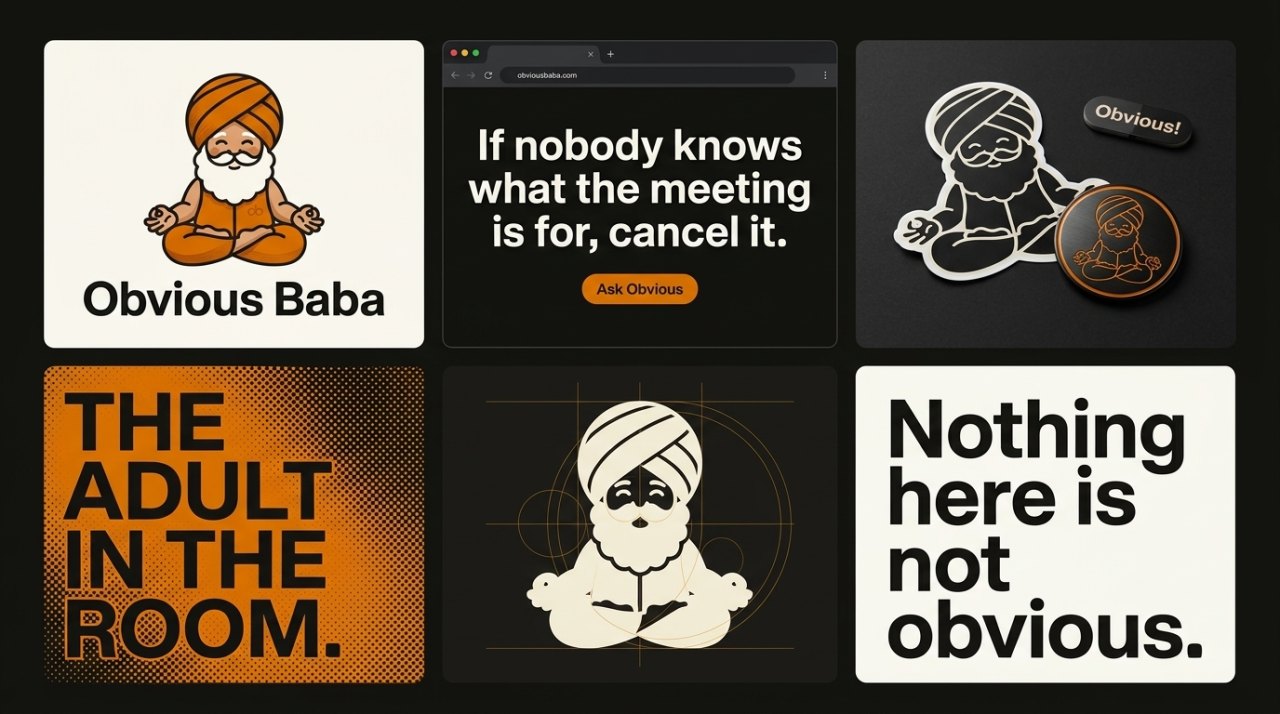
Ask Obvious
World's messiest problems, answered in two plain sentences.
AI replacement panic, seven-meeting Tuesdays, ghost jobs, and forty-tab dashboards look remarkably simple once someone says the obvious part out loud.
"Our product has 47 tabs because every big prospect asked for just one tiny extra toggle."
Obvious Answer
A pocketknife with forty blades cuts mostly the person holding it. Build one sharp blade that slices cleanly and say no with a warm smile.
T-Shirt Rule: Simplicity is earned by polite subtraction.
TheWORKCompany Cool Index & Brand System
Agents now do the work; people still answer for it. Across Club, joq, ewent.ai, skill.re, manav.id, eval.qa, Moat, and Dium, Obvious Baba keeps software honest, cuddly, and free of corporate theater.
"Most common day for a heart attack is Monday, for a reason." (Career Development). Grounded aphorisms for builders, also served via JSON API and federated custom element.