In 2011, researchers Shai Danziger, Jonathan Levav, and Liora Avnaim-Pesso analyzed 1,112 parole rulings made by eight seasoned Israeli judges over ten months. Their PNAS chart stunned legal scholars: at the start of a morning session, prisoners received parole roughly 65% of the time; by the hour before a food break, favorable rulings plunged toward zero.
Immediately after the judges ate a sandwich or lunch, approvals snapped right back to around 65%. Later statisticians noted that case scheduling order likely exaggerated the curve, yet the cognitive warning stuck. Mental fatigue loves the easiest default - saying 'no' - so never mistake an empty stomach for ironclad judgment.
Source: Danziger, Levav & Avnaim-Pesso, 'Extraneous factors in judicial decisions,' PNAS (2011), and subsequent PNAS methodological commentary (2013).
An alarm clock works much better when you stop negotiating with it.
StoryThe Four O'Clock Dictator and the Nine-Minute BribeHistory
~48 sec listen
In 1787, Concord clockmaker Levi Hutchins built the first American mechanical alarm clock for one uncompromising purpose: waking himself at 4:00 a.m. sharp. Its internal gear could not be adjusted, silenced, or bargained with; when four arrived, the bell rang until you stood up. Humanity tolerated this tyranny for 169 years until 1956, when General Electric-Telechron introduced the "Snooz-Alarm," whose existing analog gear teeth could only fit a nine-minute delay rather than ten.
Modern smartphones still preserve that accidental nine-minute truce, letting millions of people lose three tiny diplomatic summits before breakfast. Hutchins's clock had no button for "five more minutes" - which is why it actually worked.
Source: Levi Hutchins's 1787 fixed 4:00 a.m. mechanical alarm clock (Concord, NH) and GE-Telechron's 1956 Snooz-Alarm 9-minute gear-tooth constraint.
The fridge does not grow new food between your first look and your fourth look.
StoryThe Bird That Remembers Thirty Thousand PantriesNature
~46 sec listen
Each autumn in the high mountains of western North America, a single Clark's nutcracker (Nucifraga columbiana) harvests up to 30,000 whitebark pine seeds and buries them in thousands of tiny underground caches across miles of forest. Thanks to an oversized hippocampus, the bird remembers the exact landmarks of its buried pantries up to nine months later, digging straight through winter snow to eat.
Meanwhile, humans stand before a brightly lit twenty-cubic-foot refrigerator, swing the door open four times in twenty minutes, and squint past the same mustard jar as if leftovers breed in the dark. Either lower your standards or buy groceries.
Source: Ornithological spatial-memory research on Clark's nutcracker (Nucifraga columbiana) seed caching (Kamil & Balda).
If you forgot why you walked into the kitchen, it was probably for water or peace and quiet.
StoryThe Doorway That Erases Your ErrandScience
~51 sec listen
In 2011, University of Notre Dame psychologist Gabriel Radvansky ran participants through both virtual and real-world rooms, asking them to carry objects across equal distances - either staying inside one large room or stepping through a doorway into the next. Crossing a threshold consistently caused a sharp spike in forgetting. Radvansky called it the "Doorway Effect": your brain treats a new room as an "event boundary," neatly filing away the previous context to clear mental desk space.
So when you freeze in front of the pantry wondering why you walked in, relax - you aren't losing your mind. Your hippocampus just archived the living room; grab a glass of water and enjoy the quiet.
Source: Gabriel A. Radvansky, Sabine A. Krawietz & Andrea K. Tamplin (2011), 'Walking through doorways causes forgetting,' Quarterly Journal of Experimental Psychology.
Rest is not the reward for finishing everything; you will never finish everything.
StoryThe Seabird That Sleeps in MidairNature
~49 sec listen
Great frigatebirds (Fregata minor) routinely soar over the open Pacific for ten days straight - covering 3,000 kilometers without touching land - because their un-waterproofed feathers would waterlog if they landed on the sea. Waiting until the journey finished to sleep wasn't an option.
In 2016, sleep scientist Niels Rattenborg attached tiny EEG loggers to Galápagos frigatebirds and solved the mystery: while circling up warm ocean thermals, the birds switch off one brain hemisphere at a time - and even nap briefly with both hemispheres - snatching short bursts of rest on the wing. Even nature's ultimate marathoners don't wait for the ocean to end before closing their eyes.
Source: Niels C. Rattenborg et al. (2016), 'Evidence that birds sleep in mid-flight,' Nature Communications 7:12468.
You cannot negotiate with gravity, and you cannot negotiate with sleep.
StoryEleven Days Awake Until Street Signs Spoke BackScience
~51 sec listen
In January 1964, seventeen-year-old San Diego high schooler Randy Gardner decided to break the world sleep-deprivation record for a science fair project, monitored by Stanford sleep pioneer William Dement. No caffeine, no stimulants - just pure willpower against biology.
Gardner made it to 264.4 hours - eleven days and twenty-five minutes - but the bill arrived well before the finish line. By day four he hallucinated a street sign as a person; by day eleven his speech slurred, paranoia crept in, and when asked to count backward from 100 by sevens, he stopped at 65 because he forgot what he was doing. You can argue with your boss or your calendar; sleep simply shuts down the courtroom.
Source: Randy Gardner 1964 sleep deprivation study (William C. Dement, Stanford University; Psychosomatic Medicine).
A tired brain makes permanent decisions about temporary problems.
StoryThe Six-Hour IllusionScience
~55 sec listen
In 2003, sleep researchers Hans Van Dongen and David Dinges at the University of Pennsylvania kept forty-eight healthy adults in a controlled lab for two weeks, splitting them into groups allowed eight, six, or four hours of sleep a night. Every day, the volunteers took reaction-time and working-memory tests alongside a simple question: how sleepy do you feel?
By day fourteen, the six-hour sleepers performed as poorly as people who had been awake for twenty-four hours straight, while the four-hour group matched two full sleepless nights. Yet their self-ratings plateaued early - they insisted they felt "only slightly sleepy" and completely adapted. Exhaustion is a sneaky advisor: the worse your judgment gets, the more convinced you are that you are fine.
Source: Van Dongen, Maislin, Mullington, & Dinges (2003), "The cumulative cost of additional wakefulness," SLEEP journal (48 adults, 14 days).
You do not hate your life; you just skipped lunch and stared at a rectangle for six hours.
StoryHow Half-Rations Turned Cheerful Men Into Philosophers of DoomHistory
~47 sec listen
In November 1944, physiologist Ancel Keys recruited thirty-six healthy, mentally resilient young volunteers at the University of Minnesota to study how wartime starvation affected the human body and how best to refeed liberated Europe. For six months, their daily calories were slashed roughly in half.
The physical weight loss was expected; the psychological ambush was not. Within weeks, upbeat volunteers grew irritable, apathetic, socially withdrawn, and consumed by bleak despair - even obsessing over cookbooks like romance novels. Once full meals returned, their dark worldview evaporated. Before you diagnose your entire existence as a tragedy, check when you last ate something that wasn't glowing pixels.
Source: Minnesota Starvation Experiment, 1944-1945 (Ancel Keys et al., The Biology of Human Starvation, 1950).
Half of self-care is going to bed at the time you promised yourself at noon.
StoryThe Midnight Mutiny Against Noon's PromisesScience
~47 sec listen
In 2014, Utrecht University psychologist Floor Kroese and her colleagues surveyed 177 adults and gave a clinical name to one of modern life's pettiest self-sabotages: 'bedtime procrastination.' Unlike insomniacs, these people had no trouble falling asleep - and no emergency keeping them awake.
Instead, more than half regularly blew past the exact bedtime they had sensibly promised themselves at midday. Why? Because self-regulation is a battery that runs dead by 11 p.m., leaving a drained evening brain in charge of enforcing a rested noon brain's rules. Half of adulthood is realizing midnight-you cannot be trusted with the remote - and tucking yourself in anyway.
Source: Floor M. Kroese et al. (2014), 'Bedtime procrastination: introducing a new area of procrastination,' Frontiers in Psychology.
You cannot pour from an empty cup, and you cannot think with forty open tabs.
StoryFour Slots in a Head Built for Forty TabsScience
~50 sec listen
In 1956, cognitive psychologist George Miller published his landmark paper The Magical Number Seven, Plus or Minus Two, showing that human working memory can juggle only a handful of active items at once. Decades later, psychologist Nelson Cowan tightened the estimate even further: without clever chunking, our true active focus holds closer to four items.
Every extra mental tab - an unanswered text, a half-read report, a nagging errand - doesn't sit politely minimized in the background. It actively evicts the thought you were trying to finish. Trying to solve a complex problem with forty open loops is like trying to pour coffee from a mug you already turned upside down.
Source: George A. Miller (1956), Psychological Review; Nelson Cowan (2001), Behavioral and Brain Sciences.
Going for a walk without your phone feels illegal for the first five minutes and like a miracle after ten.
StorySixty Percent Smarter Once Your Boots Hit the GravelArt & Culture
~48 sec listen
Every afternoon in Vienna, Ludwig van Beethoven abandoned his cluttered desk and strode briskly through the woods carrying nothing but a pencil and folded music paper - no distractions, no callers, just footsteps and rhythm. Two centuries later, Stanford researchers Marily Oppezzo and Daniel Schwartz tested why it worked.
In their 2014 study across 176 participants, simply walking boosted creative divergent thinking by an average of 60 percent compared to sitting - and the mental spark lingered even after walkers sat back down. Leaving your phone behind feels like a minor felony for the first five minutes, right up until minute ten when your brain remembers how to breathe.
If a problem still feels urgent after a full meal and eight hours of sleep, now you have a real problem.
StoryThe Dream That Survived Until MorningScience
~54 sec listen
For years, pharmacologist Otto Loewi puzzled over whether nerves signaled organs electrically or chemically. On the night before Easter Sunday in 1921, a brilliant experiment flashed into his dream; he woke, scribbled notes in the dark, and went back to sleep - only to wake up unable to read a single word of his own handwriting.
The next night at 3:00 a.m., the dream returned. This time, rested and clear-headed, Loewi went straight to his Graz lab, stimulated one frog heart's vagus nerve, transferred its bath fluid to a second nerveless heart, and watched it slow down - discovering acetylcholine and winning the 1936 Nobel Prize. Midnight panic fades by breakfast; real breakthroughs are still waiting after eight hours of sleep.
Source: Otto Loewi's Easter 1921 frog-heart experiment & 1936 Nobel Prize in Physiology or Medicine (NobelPrize.org).
StoryThe Day Magellan's Crew Lost at SeaExploration
~52 sec listen
On July 9, 1522, the battered Spanish carrack Victoria - the sole surviving ship of Ferdinand Magellan's expedition, now captained by Juan Sebastián Elcano - dropped anchor at the Cape Verde Islands. Chronicler Antonio Pigafetta had faithfully logged every single sunrise for nearly three years without missing an entry. His journal swore it was Wednesday.
When sailors rowed ashore to buy food, Portuguese locals insisted it was Thursday, July 10. The crew panicked, convinced they had miscounted their holy days. Only later did astronomers realize their westward circumnavigation had chased the sun around the Earth, stretching each day by minutes until a full 24 hours vanished. Even when you keep a flawless calendar, today refuses to stay put.
Source: Antonio Pigafetta, 'The First Voyage Around the World' (1522); Royal Observatory Greenwich records on the International Date Line.
At the stroke of midnight on Thursday, December 29, 2011, the entire nation of Samoa jumped straight into Saturday, December 31. Friday, December 30 never happened. For 119 years, Samoa had sat east of the International Date Line, leaving businesses a full day behind their biggest trading partners in Sydney and Auckland - when Australia opened on Monday, Samoa was still in church on Sunday.
By hopping west across the Date Line, Samoa erased a whole Friday off the map (and still legally paid workers for the missing shift). Even so, citizens still woke up on Saturday looking back at Thursday. You can delete a date by act of parliament, and tomorrow will still line up politely behind yesterday.
Source: Government of Samoa International Date Line Act 2011; The Guardian & Smithsonian Magazine coverage (Dec 2011).
In 1888, Scottish veterinarian John Boyd Dunlop grew tired of watching his ten-year-old son bounce painfully across Belfast cobblestones on a solid-rubber tricycle. Using a rubber garden hose, linen strips, and a football pump, Dunlop wrapped a cushion of trapped air around the rims and patented the pneumatic tire.
When cyclist Willie Hume rolled onto the Queen's College Sports track in Belfast on May 18, 1889, rivals riding solid rubber mocked his puffy 'sausage wheels.' Hume entered four races and won all four. Solid rubber had been rolling for decades, yet nobody realized the real engineering upgrade was empty space. Sometimes the most valuable part of a heavy machine is the nothing you pump inside it.
Source: Belfast Queen's College Sports records (May 18, 1889); Ulster Transport Museum & Dunlop historical archives.
StoryThe Foot-Powered Highway of the AndesExploration
~50 sec listen
Long before asphalt or engines, the Inca Empire carved the Qhapaq Ñan - over 30,000 kilometers of stone-paved highways, suspension bridges, and mountain staircases stitching together peaks above 4,000 meters from Colombia to Chile. They built the entire network without a single horse or wheeled cart.
What turned cold Andean stone into a living nervous system was the chasqui: relay runners stationed every few kilometers in stone tambo waystations, blowing conch shells as they sprinted up to 240 kilometers a day in relays, carrying knotted quipu records and even fresh coastal fish to the emperor in Cusco. Strip away the runners and the world's greatest highway is just organized gravel waiting for feet.
Source: UNESCO World Heritage Centre, 'Qhapaq Ñan, Andean Road System' dossier.
In June 1985, payload specialist Prince Sultan bin Salman Al Saud peered through the windows of Space Shuttle Discovery during mission STS-51-G alongside American and French crewmates. Looking down from low Earth orbit, he noticed a quiet psychological shift sweeping through the cabin - what space philosopher Frank White would later name the Overview Effect.
Speaking in Cernay, France that October, Al Saud summed up the week in three sentences: 'The first day or so we all pointed to our countries. The third or fourth day we were pointing to our continents. By the fifth day, we were aware of only one Earth.' Turns out the lines people fight wars over cannot survive a window seat.
Source: Sultan bin Salman Al Saud, First Congress of the Association of Space Explorers (Oct 2, 1985); Frank White, 'The Overview Effect' (1987).
StoryThe Eleven-Day Pacific Sprint of Bird 234684Nature
~49 sec listen
On October 13, 2022, a five-month-old bar-tailed godwit (Limosa lapponica) wearing satellite tag 234684 lifted off from Alaska's Yukon-Kuskokwim Delta and pointed itself straight across the open Pacific. For 11 days and 1 hour - 265 continuous hours - the juvenile bird never landed, never ate, and never drank a drop of water.
By the time it touched down at Ansons Bay in northeastern Tasmania on October 24, it had flown a world-record 13,560 kilometers nonstop, having likely overshot its usual wintering grounds in New Zealand. Yet even the greatest endurance flyer on the planet eventually had to drop its skinny legs into the mud and catch its breath. No engine, feathered or jet-fueled, runs forever.
Source: USGS Alaska Science Center & Guinness World Records (Oct 2022).
StoryThe Wind That Locked Skyscrapers ShutEngineering
~50 sec listen
As late-19th-century cities began stacking offices higher into the sky, architects hit an unexpected physics wall: the stack effect. Warm indoor air rushed up elevator shafts like a chimney, creating fierce pressure differentials at street level that literally sucked hinged entrance doors shut - requiring a full-body shove just to step inside.
On August 7, 1888, Philadelphia inventor Theophilus Van Kannel patented a clever fix: a four-winged 'storm-door structure' that equalized air pressure on all sides, first installed at Rector's restaurant in Times Square in 1899. When a door refuses to budge, pushing harder rarely solves the physics. Sometimes you have to change the hinge before you can cross the threshold.
Source: U.S. Patent No. 387,571 (Aug 7, 1888); 99% Invisible & architectural histories of Rector's (1899).
Do not wish to own everything; you would have nowhere to put it.
StoryFourteen Pianos in a Harlem BrownstoneHistory
~50 sec listen
In March 1947, New York police answering an anonymous tip had to break through a second-story window of a Harlem brownstone at Fifth Avenue and 128th Street because the front door was sealed behind a solid wall of debris. Inside lived the Collyer brothers, Homer and Langley, who had spent decades refusing to throw anything away.
Crews spent weeks hauling out an estimated 120 to 140 tons of newspapers, books, a Model T chassis, and 14 pianos. Buried inside a labyrinth of booby-trapped tunnels, police found Langley crushed to death by a collapsing booby trap of his own possessions, leaving blind Homer to starve nearby. Collect enough things, and eventually your things collect you.
Source: New York Times archives (March-April 1947); NYC Parks historical record on Collyer Brothers Park.
Every airline passenger tunes out the flight attendant's plea to 'secure your own oxygen mask before assisting others,' yet the rule is written in ruthless physiology. According to Federal Aviation Administration data, if a jetliner loses cabin pressure at 35,000 feet, your Time of Useful Consciousness is only 30 to 60 seconds - and half that during rapid decompression.
Hypoxia does not announce itself with drama; it sneaks in as dizzy euphoria while your fingers forget how to pull a strap. A parent who spends twenty seconds wrestling a child's mask risks slumping unconscious before either person can breathe. Martyrdom at altitude saves nobody; staying conscious is the prerequisite for kindness.
Do not worry about killing time; eternity is fine.
StoryThe Clock Inside a Texas MountainEngineering
~50 sec listen
Deep inside a hollowed-out limestone shaft in West Texas's Sierra Diablo mountains, engineers from the Long Now Foundation have been assembling a 500-foot mechanical timepiece designed by computer scientist Danny Hillis. Built from titanium, ceramic, and marine-grade stainless steel, it is engineered to run for 10,000 years.
Its pointer hand advances once a year, its century hand ticks once every hundred years, and its cuckoo emerges once a millennium - powered by day-night thermal cycles and occasional human winding. Meanwhile, most of us stare furiously at a microwave with twelve seconds left. Relax: the universe has plenty of spare hours, and none of them are bruised by your afternoon nap.
Source: The Long Now Foundation, 'The 10,000 Year Clock' engineering documentation.
Someone had to step on the grass to plant the "Keep off the Grass" sign.
StoryThe Sidewalks Students Carved With MudArt & Culture
~53 sec listen
When buildings first rose around the 11-acre green at the heart of The Ohio State University in the late 19th century, campus planners did not lay down a rigid grid of sidewalks. Students walking between classes simply took the shortest diagonal lines across the lawn, trampling muddy trails - what urban planners call 'desire paths.'
Rather than fighting human footwear with endless fences and scolding signs, OSU eventually paved over the exact mud tracks students had worn into the grass, creating the Oval's famous crisscrossing web around the Long Walk. Every rule against shortcuts begins with someone walking across the lawn to enforce it - and the grass always remembers where people actually wanted to go.
Source: The Ohio State University Archives ('The Oval' and 'Long Walk' campus planning history).
A thermos does not need to know if it is holding hot or cold; it just does its job.
StoryThe Liquid-Oxygen Flask That Sold SoupScience
~50 sec listen
In 1892, Scottish physicist Sir James Dewar stood in his Royal Institution lab in London trying to keep liquefied oxygen - boiling at a frigid -183°C - from evaporating before he could study it. His solution was a double-walled silvered glass vessel with the air pumped out between the walls, starving heat of any medium to conduct or convect.
Dewar never patented his vacuum flask. Twelve years later, German glassblowers Reinhold Burger and Albert Aschenbrenner realized the same barrier that kept heat out could keep heat in, trademarking 'Thermos' in 1904 for hot coffee and soup. Good boundaries do not need to judge what they protect; they simply hold the line.
Source: Royal Institution archives on James Dewar (1892); Thermos GmbH patent/trademark history (1904).
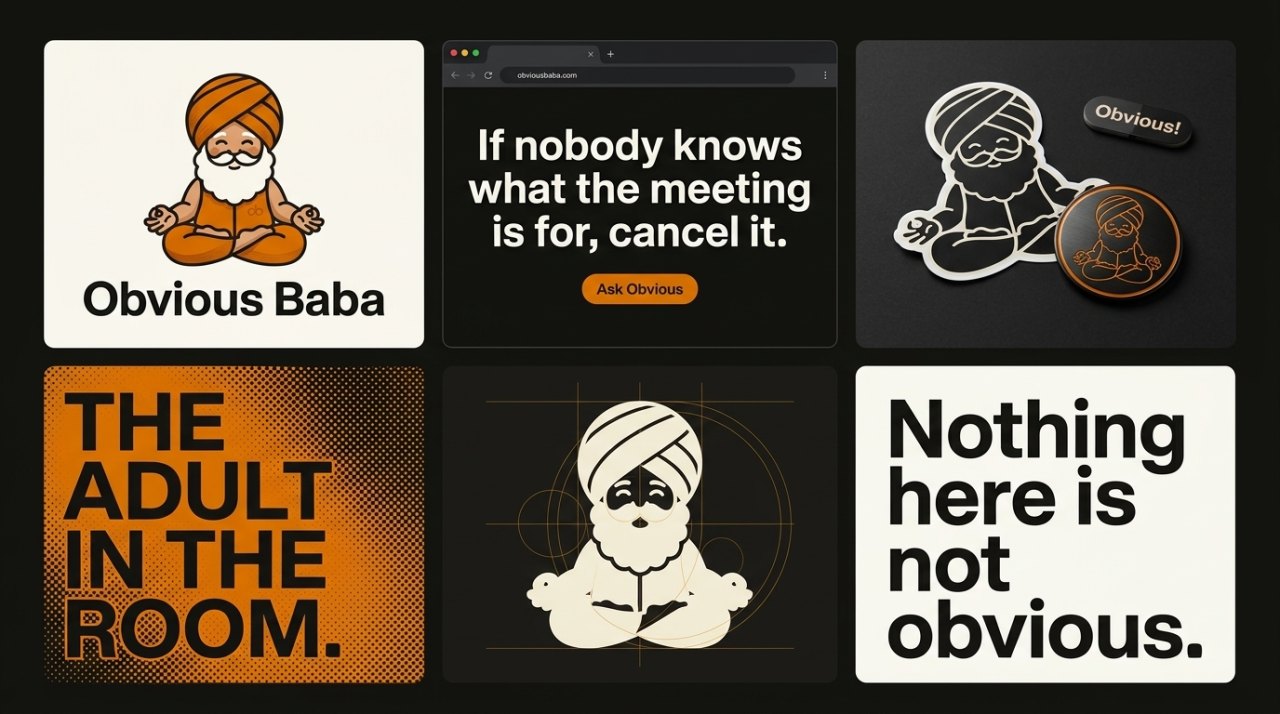
Ask Obvious
World's messiest problems, answered in two plain sentences.
AI replacement panic, seven-meeting Tuesdays, ghost jobs, and forty-tab dashboards look remarkably simple once someone says the obvious part out loud.
"Our product has 47 tabs because every big prospect asked for just one tiny extra toggle."
Obvious Answer
A pocketknife with forty blades cuts mostly the person holding it. Build one sharp blade that slices cleanly and say no with a warm smile.
T-Shirt Rule: Simplicity is earned by polite subtraction.
TheWORKCompany Cool Index & Brand System
Agents now do the work; people still answer for it. Across Club, joq, ewent.ai, skill.re, manav.id, eval.qa, Moat, and Dium, Obvious Baba keeps software honest, cuddly, and free of corporate theater.
"Most common day for a heart attack is Monday, for a reason." (Career Development). Grounded aphorisms for builders, also served via JSON API and federated custom element.